
General architecture
Contents
General architecture#
The following architecture has the aim to cover and support the goals presented in the overview section.
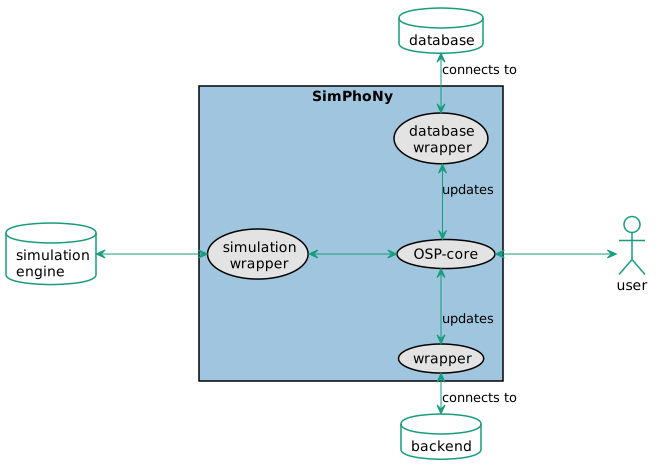
Interoperability concept#
As you can see, OSP-core provides the standard data format and API, and the wrappers take care of mapping that format to and from the backend specific syntax and API.
In order to simplify and generalise the usage as much as possible, the backend specific and syntactic knowledge should be abstracted to ontology concepts that encompass all third party tools.
For that, a 3 layer schema is used:
![skinparam {
linetype ortho
Shadowing false
BackgroundColor transparent
RectangleBackgroundColor #E3E3E3
RectangleBorderColor black
ActorBackgroundColor transparent
ActorBorderColor #179c7d
DatabaseBackgroundColor transparent
DatabaseBorderColor #179c7d
PackageBorderColor #55A5D9
PackageBackgroundColor transparent
ArrowColor #179c7d
ranksep 10
}
skinparam rectangle<<invisible>> {
BorderColor Transparent
BackgroundColor transparent
stereotypeFontColor transparent
}
Actor user
rectangle "semantic layer" as sem {
}
rectangle "interoperability layer" as intop {
}
rectangle "syntactic layer" as syn {
}
database backend
rectangle gen<<invisible>>[
Ontology aware, generic\t
]
rectangle spe<<invisible>>[
\tEngine specific knowledge
]
' -----------------------
' ------ RELATIONS ------
' -----------------------
user <-> sem
sem <-> intop
intop <-> syn
syn <-> backend
user -[hidden]-> gen
gen -> spe
backend -[hidden]-> spe](_images/plantuml-96df4755f4e26050f3eb9bed1a46847255270684.svg)
Three layered design#
The Semantic layer are the classes generated from the ontology with the CUDS API.
The Interoperability layer maps the changes in the semantic layer to calls in the syntactic layer.
The Syntactic layer provides access to the backend.
The closer to the user, the closer to the ontology concepts. The abstraction is replaced by specificity when you move towards the backend.
For example, the City, Street or Neighborhood classes from the demonstrative City Ontology included in OSP-core, as well as the individuals that can be instantiated using them, would be part of the semantic layer. Any wrapper (e.g. the included SQLite wrapper), would be part of the interoperability layer. Finally, following the SQLite example, the sqlite3 library from python would be part of the syntactic layer.
For a full explanation on the architecture and design, go to detailed design.
OSP-core#
OSP-core is the main component of the SimPhoNy framework. It is independent of any backend and provides the basic ontology based data structures for the seamless exchange of data between wrappers.
Ontology file#
OSP-core requires an ontology file to create the appropriate CUDS classes.
Said ontology must be either in a YAML format as defined by our specification or one of the supported owl ontologies.
YAML Ontology sample
The following is an excerpt from the `city.ontology.yml` in osp-core. ---
version: "0.0.3"
namespace: "city"
ontology:
encloses:
subclass_of:
- cuba.activeRelationship
inverse: city.isEnclosedBy
isEnclosedBy:
subclass_of:
- cuba.passiveRelationship
inverse: city.encloses
hasInhabitant:
subclass_of:
- city.encloses
################
CityWrapper:
subclass_of:
- cuba.Wrapper
- city.hasPart:
range: city.City
cardinality: 1+
exclusive: false
################
City:
subclass_of:
- city.PopulatedPlace
- city.hasPart:
range: city.Neighborhood
cardinality: many
exclusive: true
- city.isPartOf:
range: city.CityWrapper
cardinality: 0-1
exclusive: true
- city.hasMajor:
range: city.Citizen
cardinality: 0-1
exclusive: true
Building:
subclass_of:
- city.ArchitecturalStructure
- city.hasPart:
range: city.Address
cardinality: 1
exclusive: false
- city.hasPart:
range: city.Floor
cardinality: many
exclusive: false
- city.isPartOf:
range: city.Street
cardinality: 1
exclusive: true
Citizen:
subclass_of:
- city.Person
OSP-core can be used with EMMO (Elementary Multiperspective Material Ontology) out of the box. See more here.
Python classes#
Upon installation of OSP-core, each ontology class (except from attributes and relationships) becomes a python class.
Since each ontology has a namespace, it can be used to import the classes and create cuds objects:
from osp.core.namespaces import cuba, another_namespace

entity = cuba.Entity()
other_entity = another_namespace.SomeOtherEntity()
Sessions#
The sessions are the interoperability classes that connect to where the data is stored. In the case of wrappers, they take care of keeping consistency between the backends (e.g. databases) and the internal registry.
The CoreSession is the default one used when instantiating a new object in your workspace. When you add an object to a wrapper, a copy of the object is created in the registry belonging to the session of the wrapper.
Wrappers#
Like we have mentioned in previous sections, wrappers allow the user to interact through the cuds API with different backends.
Since each backend is different, for more detailed documentation of each wrapper we suggest going through the different available repositories.
For more technical information regarding wrappers, particularly for wrapper developers, we recommend visiting wrapper development.