
Detailed design
Contents
Detailed design#
Here we will give an in-depth view of the design of the 3 layers.
For a more general overview, go to general architecture.
![skinparam {
Shadowing false
BackgroundColor transparent
ClassBackgroundColor #E3E3E3
ClassBorderColor black
ActorBackgroundColor transparent
ActorBorderColor #179c7d
InterfaceBackgroundColor transparent
InterfaceBorderColor #179c7d
DatabaseBackgroundColor transparent
DatabaseBorderColor #179c7d
PackageBorderColor black
PackageBackgroundColor #9FC6DE
ArrowColor #179c7d
}
allow_mixing
actor User
circle pico
rectangle SemanticLayer {
class Cuds {
Session session
UUID uuid
OntologyEntity oclass
--
add() : Cuds
get() : Cuds
remove() : void
update() : void
iter() : Iterator<Cuds>
}
abstract class OntologyEntity {
String name
URIRef iri
String tblname
OntologyNamespace namespace
Set direct_superclasses
Set direct_subclasses
Set superclasses
Set subclasses
String description
--
get_triples() : triple
is_superclass_of() : bool
is_subclass_of() : bool
}
class OntologyClass implements OntologyEntity {
Dict attributes
Dict own_attributes
}
class OntologyRelationship implements OntologyEntity {
OntologyRelationship inverse
}
class OntologyAttribute implements OntologyEntity {
URIRef datatype
--
convert_to_datatype() : Any
convert_to_basic_type() : Any
}
class OntologyNamespace {
--
get_iri() : URIRef
get_default_rel() : OntologyRelationship
get() : OntologyEntity
}
class NamespaceRegistry {
--
get() : OntologyNamespace
update_namespaces() : void
from_iri() : OntologyEntity
clear() : Graph
store() : void
load() : void
}
}
rectangle InteroperabilityLayer {
class Registry <dict> {
}
abstract class Session {
Registry : registry
--
store() : void
load() : Cuds
sync() : void
}
class SomeWrapperSession implements Session {
List added
List updated
List removed
SyntacticLayer syntactic
--
}
}
rectangle SyntacticLayer {
class SyntacticLayer {
}
}
database backend
' -----------------------
' ------ RELATIONS ------
' -----------------------
User -up-> OntologyClass : interacts_with
Cuds -left> OntologyClass : instance_of
OntologyEntity -> OntologyNamespace : part_of
OntologyNamespace -> NamespaceRegistry : contained_in
OntologyClass -left> OntologyAttribute : has
pico -> NamespaceRegistry : manages
Cuds -> Session : has_a
Session -> Registry : manages
SomeWrapperSession -> SyntacticLayer : manages
SyntacticLayer -> backend : acts_on
OntologyRelationship -[hidden]> OntologyAttribute](_images/plantuml-05d23f07d39858b79617eade6f84b27991b3e275.svg)
Standard design#
Semantic layer#
The semantic layer is the representation of the classes of the ontology in a programming language.
When the user installs an ontology through pico,
all ontology concepts are saved in a graph in ~/.osp_ontologies.
The procedure is as follows:
The
OntologyInstallationManagerreceives a list of yml files with ontologies to install.It instantiates a
Parser.The parser goes through the ontologies and creates an
OntologyClassper entity.All the oclasses of the same namespace are grouped in an
OntologyNamespace.All the registries are collected in the
NamespaceRegistry.
Installing new ontologies loads the graph and adds new namespaces or modifies the existing ones.
When a class is instantiated, an individual is created. The graph is read, and an instance of the Cuds class with the ontology information is created.
Through the Cuds they realise the Cuds API which enables the user to work with them in a generic, simple way.
Cuds#
Location: osp.core.cuds
It is the base class for all instances. Besides whatever might have been defined in the ontology, they all have 3 basic attributes:
uid: instance of
uuid.UUID, it serves to uniquely identify an instance.session: this is the link to the interoperability layer. By default all objects are in the
CoreSession, unless they are in a wrapper.oclass: indicates the ontology class they originate from.
Cuds structure#
Each cuds object contains the uids and oclass of the directly related entities, as well as the relationship that connects them. The actual related objects are kept in the registry.
 a_cuds_object :=  {
    Relation1: {uid1: oclass, uid2: oclass},
    Relation2: {uid4: oclass},
    Relation3: {uid3: oclass, uid5: oclass},
    }
Note
This is an abstraction to show the general structure. The actual implementation is a bit more complex.
Cuds API#
The governing idea behind the API design was to simplify as much as possible the usage.
This CRUD API is defined by 6 methods:
Create#
from osp.core.namespaces import some_namespace

ontology_class = some_namespace.OntologyClass
relationship = some_namespace.relationship
cuds_obj = some_namespace.OntologyClass()
Add#
# These will also add the opposed relationship to the new contained cuds object
cuds_obj.add(*other_cuds, rel=relationship)
cuds_obj.add(yet_another_cuds)  # Uses default relationship from ontology
The flow of information for the call of the add method would be:
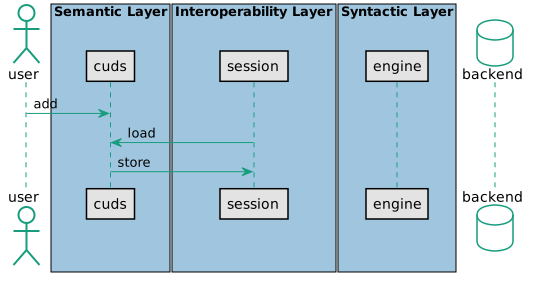
add method call#
As you can see, the information is sent to the next layer, but not all the way to the backend.
This will be propagated when the user calls session.run() or session.commit.
The registry is checked for a pre-existing object, in case something that is already there is being added.
Get#
# Returns a list, unless only one uid was given
cuds_obj.get()                                           # All the contained cuds objects
cuds_obj.get(rel=relationship)                           # Entities under that relationship
cuds_obj.get(*uids)                                      # Searches elements for the uids
cuds_obj.get(*uids, rel=relationship)                    # Faster, filters by relationship
cuds_obj.get(oclass=ontology_class)                      # Elements of that class
cuds_obj.get(rel=relationship, oclass=ontology_class)    # Filters by rel and oclass
In this case, the calls carried out by the get method are as follows:
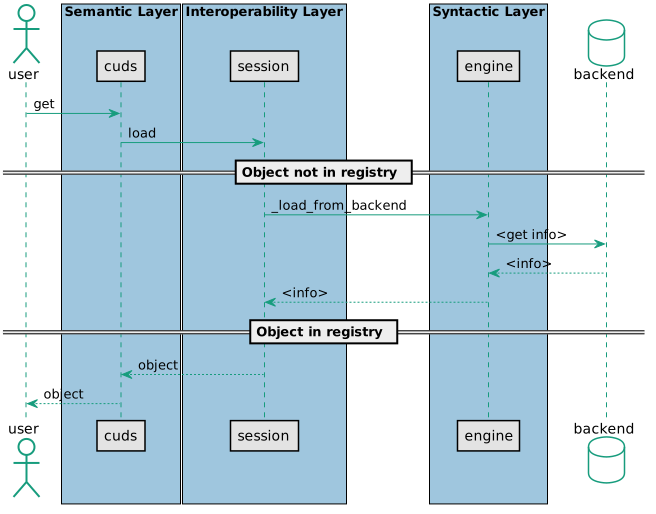
get method call#
Now the backend is contacted to make sure the user receives the latest
available version of the objects being queried.
This is done through _load_from_backend().
Update#
# Objects to update must exist already
cuds_obj.update(*cuds_objs)
A simple update call triggers the following behaviour:
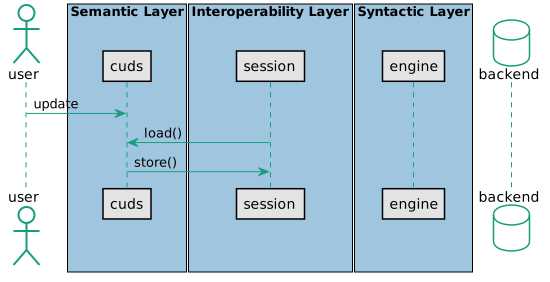
update method call#
You can see the calls are very much the same as with the add method.
The difference is that the update requires the object to be there previously.
And so the object is first loaded from the registry, then updated and stored.
Remove#
# These will trigger the update in the opposed relationship of the erased element
cuds_obj.remove()                                        # Remove all
cuds_obj.remove(*uids/cuds_objs)                         # Remove objects with the given uids
cuds_obj.remove(*uids/cuds_objs, rel=relationship)       # Faster, filters by relationship
cuds_obj.remove(rel=relationship)                        # Delete all elements under a relationship
cuds_obj.remove(oclass=ontology_class)                   # Delete all elements of a certain class
cuds_obj.remove(rel=relationship, oclass=ontology_class) # Delete filtering by rel and oclass
The sequence for a simple remove is:
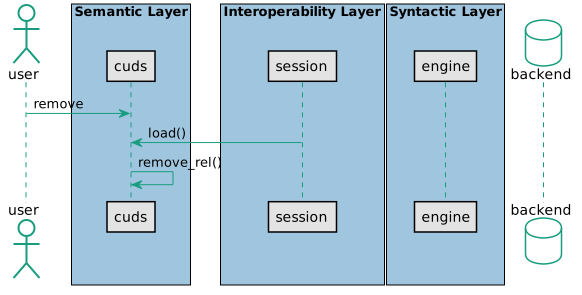
remove method call#
Here the registry is accessed to fetch the neighbours of the removed object and delete their links (relationships) to it.
Iterate#
cuds_obj.iter()                                          # Iterates through all
cuds_obj.iter(oclass=ontology_class)                     # Iterates filtering by the ontology class
cuds_obj.iter(rel=relationship)                          # Iterates filtering by the relationship
The general behaviour of the iter is:
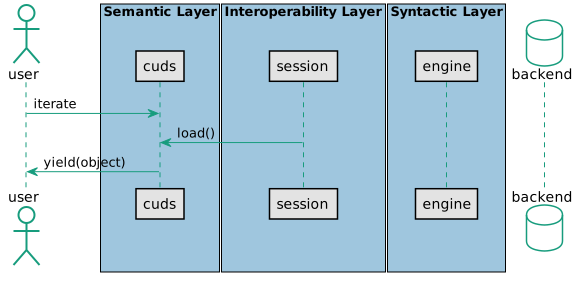
iter method call#
First the uids of all the objects to be iterated are gathered, and then they are yielded like a generator
Hint
There is also an is_a method for checking oclass inheritance.
Note
Be aware that the sequence diagrams shown represent simple use cases, and more complex scenarios are also possible (e.g. adding an object with children).
Interoperability layer#
The interoperability layer takes care of the connection and translation between the semantic and syntactic parts. It also contains the storage of all the objects that share a session.
Registry#
Location: osp.core.session.registry
This flat datastructure stores all the objects in the same workspace (session) by their uid. It is accessed through the session, and invisible to the user.
It also has functionality for pruning, resetting, or filtering its elements.
Session#
Location: osp.core.session
The main purpose of session objects is to propagate the changes introduced by the user (and stored in the registry) to the backend, and update the registry with the modifications coming from the backend.
The backend is accessed via the Syntactic layer, through the _engine property.
To simplify and group functionality, we built an inheritance scheme:
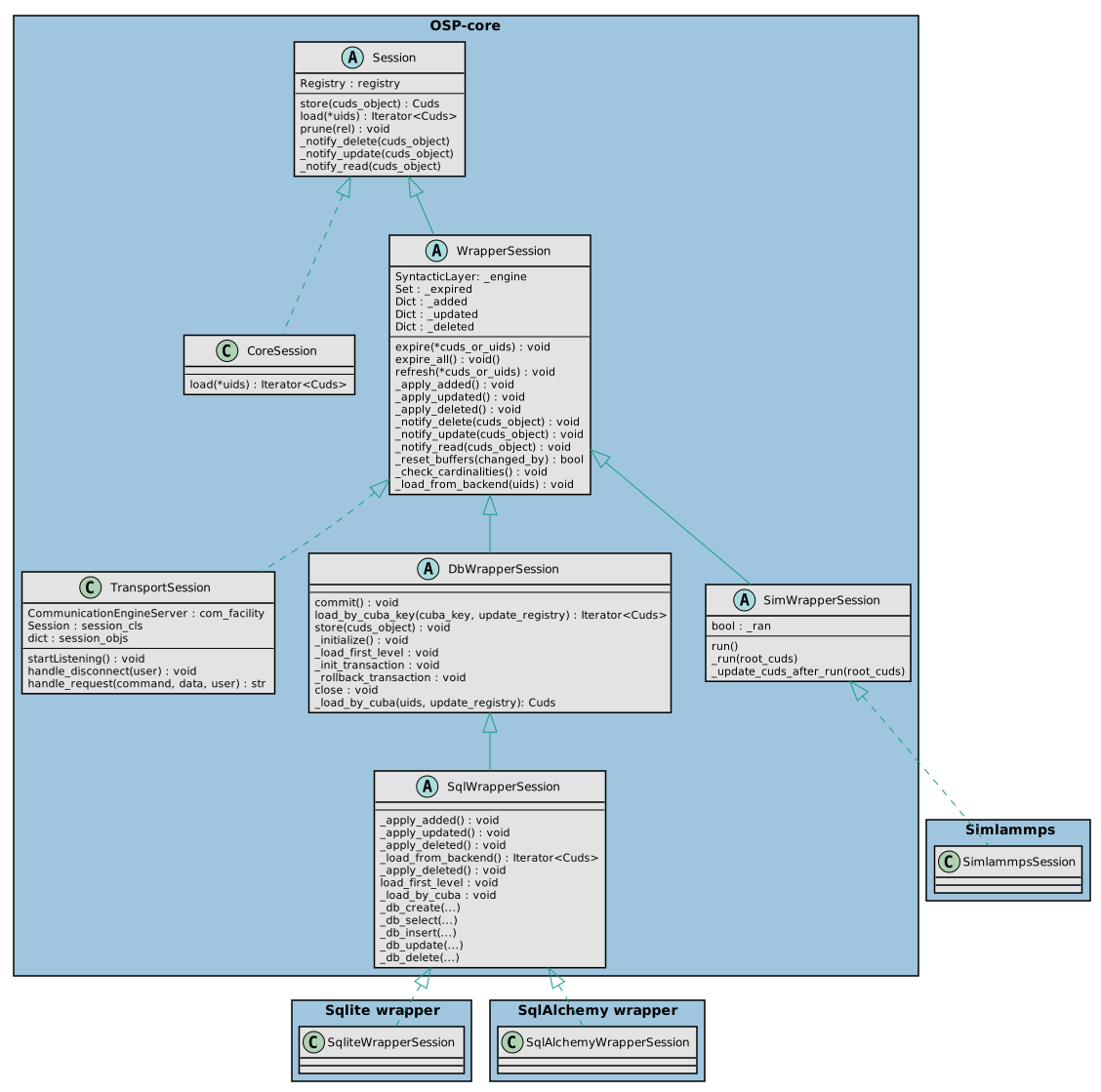
Session inheritance scheme#
Note
This is a reduced version and does not represent the entirety of the contained functions.
The simplest session, called CoreSession, is the default one for entities created in a python workspace
and has no backend. It just accesses the registry to manage the operations made by users.
All wrappers will share WrapperSession as an ancestor.
This will define which methods have to be implemented and _engine as the access point to a backend.
SimWrapperSession and DbWrapperSession further specify the behaviour of wrappers, defining the methods that
trigger an action on the backend (run and commit, respectively).
Note
You might have noticed that the semantic layer defines remove in the API,
but in the session and registry we use delete. The different between them
is conceptual: remove is interpreted as detachment i.e. removal of edges,
while delete implies the erasure of the node itself.
Buffers#
Session classes under WrapperSession share 3 types of buffers, namely added, updated and deleted.
The previous buffers are repeated twice, first for the user and then for the engine,
so the number of buffers is actually 6.
As we have seen in the previous section, not all API calls trigger a change all the way to the backend. In fact, most of them do not. This is done to limit the traffic in the slower sections (networking or communicating with the engine).
On the other hand, the user should be able to access the latest version of the data
(meaning the changes they might have just done), and the wrapper should know what changes have taken place
since the last sync with the backend software (commit or run).
In order to achieve these, the changes done by the user directly modify the semantic layer and are
flagged in the buffers as changes to be propagated
Users or wrapper developers do not have to worry about updating this buffers, OSP-core handles them (both filling them up and emptying them).
However, these structures will be used in the different _apply_<buffer> methods when developing a wrapper
(see this section of wrapper development).
Load from Backend#
Similar to how the _apply_<buffer> methods are used to send information to the engine,
_load_from_backend has the purpose of updating the semantic layer with the latest information from the backend.
You can see in the get sequence diagram that when the information has potentially
changed in the backend (i.e the simulation has run, or a database has more data)
the get has to fetch the latest version.
To achieve this, OSP-core calls _load_from_backend with the list of desired uids,
and the wrapper wrapper will update the objects in the registry with the relevant
information and yield them.
Networking#
Location: osp.core.session.transport
You may have noticed in the session inheritance scheme that there is TransportSession implementing the WrapperSession.
This session class is the way to connect to engines that are located in other machines through web sockets.
The behaviour is as follows:
The user instantiates a
TransportSessionClientand provides the session class of the remote server, the hostname and the port.The
TransportSessionClientwill connect to aTransportSessionServerthrough aCommunicationEngineClient.The server has the wrapper package installed locally.
CommunicationEngineClientandCommunicationEngineServer(one on each side) take care of the communication, so that:The methods that the user would call on the remote wrapper are encoded with the relevant data (in json) and sent to the server.
The server deserialises the data and calls the method on the wrapper.
The results are serialised and sent back to the user´s local transport session.
The chosen implementation hides most of the work from the users and wrapper developers. The only difference between a local wrapper and a remote one is the line where the wrapper session is instantiated, from:
sess = SomeWrapperSession(parameter_a, parameter_b)
wrapper = AWrapperInstance(session=sess)
to:
# Once the server is properly setup
sess = TransportSessionClient(SomeWrapperSession, host, port,
                              parameter_a, parameter_b)
wrapper = AWrapperInstance(session=sess)
Syntactic layer#
This layer is in direct communication with the backend. It has no ontological knowledge and must just provide a simple interface for the interoperability layer to interact with the wrapped application.
This means it may have to be a binding if the application is in a different language. It could also be a file generator/parser for backends that only allow file i/o. In other cases, (e.g. LAMMPS with PyLammps) it is provided by the backend itself, and requires no implementation.
Since the syntactic layer will greatly depend on the specific backend, no standardisation is provided there.